Decision guide
Cabinet refacing vs. painting vs. replacing: which one does your kitchen need?
Three ways to change how a kitchen looks, at very different prices. Here's how to tell whether your cabinet boxes are worth keeping, what each option typically costs, and which finishes hold up in a Coachella Valley summer.
- Free for homeowners
- Licenses checked at CSLB
- You contract directly with your pro

Quick answer
Refacing is usually cheaper than new cabinets, but not always by as much as people expect. National guides put refacing at roughly $1,500 to $12,500 for a kitchen, about $7,000 typical (Inch Calculator), and installed stock-to-semi-custom cabinets at roughly $4,000 to $14,000 (Fixr). The real saving with refacing is that your countertops, plumbing and flooring usually stay put.
Who to call: Coachella Valley Remodeling connects you with our licensed partner contractor, who visits and gives you a written price. Free to you. Get a cabinet quote or call (760) 766-2218.
Most kitchen cabinets get replaced because they look tired, not because they've failed. That matters, because the cabinet boxes are the most expensive part of a kitchen to replace and the part you look at least. If the boxes are sound, painting or refacing can change the room for a fraction of the cost. If they aren't, putting new doors on them is money spent on a problem you'll have again.
This guide walks through the three options, what each one typically costs, and the desert-specific questions that change the answer.
The three options in plain terms
- Painting. Your existing doors, drawer fronts and boxes are cleaned, degreased, sanded, primed and sprayed. Hinges and hardware usually get replaced. The layout, counters and sink stay exactly as they are.
- Refacing. The boxes stay. Their visible faces get a new veneer or laminate skin, and the doors and drawer fronts are replaced with new ones, often in a different style, like flat slab or shaker. New hinges, soft-close hardware and pulls go on at the same time. Counters normally stay.
- Replacing. Everything comes out down to the walls: boxes, doors, counters (they rarely survive removal) and often the sink and backsplash. New cabinets go in, either in the same layout or a new one.
What each one typically costs
These are national ranges from published cost guides. There's no Coachella Valley series, so treat them as a starting point and let itemized bids give you your real number.
| Option | Typical range (national) | Common unit pricing | What usually stays |
|---|---|---|---|
| Painting | $2,500–$6,500, about $4,000 typical (Fixr) | About $70–$125 per door | Boxes, doors, counters, layout |
| Refacing | $1,500–$12,500, about $7,000 typical (Inch Calculator) | Per linear foot: laminate $90–$110, wood veneer $150–$200, solid wood $200–$500 | Boxes, counters, layout |
| Replacing (cabinets installed) | $4,000–$14,000, about $7,000 typical (Fixr) | Per linear foot: stock $100–$300, semi-custom $150–$650, custom $500–$1,200 | Usually nothing |
Two things the table hides:
- Replacement almost always pulls the countertops with it. The cabinet number above doesn't include new counters, a new sink, plumbing reconnection, backsplash or wall and floor patching. Installed mid-grade quartz alone runs about $75–$125 per square foot (Fixr). That's why replacing often lands closer to a minor remodel, which averaged $29,765 in Los Angeles in Remodeling's 2025 Cost vs. Value report.
- Refacing quotes vary wildly. Among the public complaints we reviewed, homeowners described refacing quotes of $18,000 and $31,000 for work they later had done for roughly a third of that. Get at least two itemized bids, and compare door material, box veneer, hardware brand and the number of doors and drawers line by line.
Kitchen & cabinet cost estimator
Typical installed range Estimate
$69,000 – $103,500
Anchored to kitchen remodeling costs from Remodeling Cost vs. Value 2025, Los Angeles. Size and finish adjustments are our rough rules of thumb, not a quote. Only a contractor's written, itemized bid after a site visit is a real price.
Start with the boxes: are they worth keeping?
Open every lower cabinet with a flashlight. You're checking the parts you'd keep with painting or refacing.
Good signs:
- Boxes are plywood or solid wood face frames, square and firmly attached to the wall.
- Shelves don't sag, and the floor of the sink base is dry and firm.
- The layout works for you: you're happy with where the sink, range and fridge sit.
Warning signs:
- Swollen particleboard, especially in the sink base and next to the dishwasher. Hard water leaks from supply lines and failed dishwasher valves are common here; Desert Water Agency groundwater averaged 240 mg/L of hardness in its 2025 report, about 14 grains per gallon.
- Soft, crumbling wood or mud tubes behind the toe-kick. UC IPM calls the desert subterranean termite the most destructive subterranean species in southeastern California's desert (Pest Note 7415).
- Toe-kicks and lower panels that took water in a flood. If your home took water during Hurricane Hilary in 2023, check here first.
- A layout you'd change anyway. Refacing a kitchen you'll gut in five years is spending twice.
If two or more warning signs apply, replacing is usually the honest answer. A good contractor will tell you that even when refacing is the bigger sale for them.
The desert heat question
The valley adds a factor most national guides skip. Summer highs regularly run past 104°F (Wikipedia, Coachella Valley), and many homes sit closed up for months with the AC set high or off.
- Thermofoil (a vinyl film heat-pressed over MDF) is the finish that shows up most in the warranty fights we read. The film can lift and peel at the edges near ovens, dishwashers, west windows and in hot, closed-up houses. If your current doors are thermofoil and peeling, don't reface with thermofoil again.
- Rigid laminate refacing relies on adhesive. Ask what adhesive is used and what its temperature rating is, and whether the warranty covers a home left unoccupied in summer.
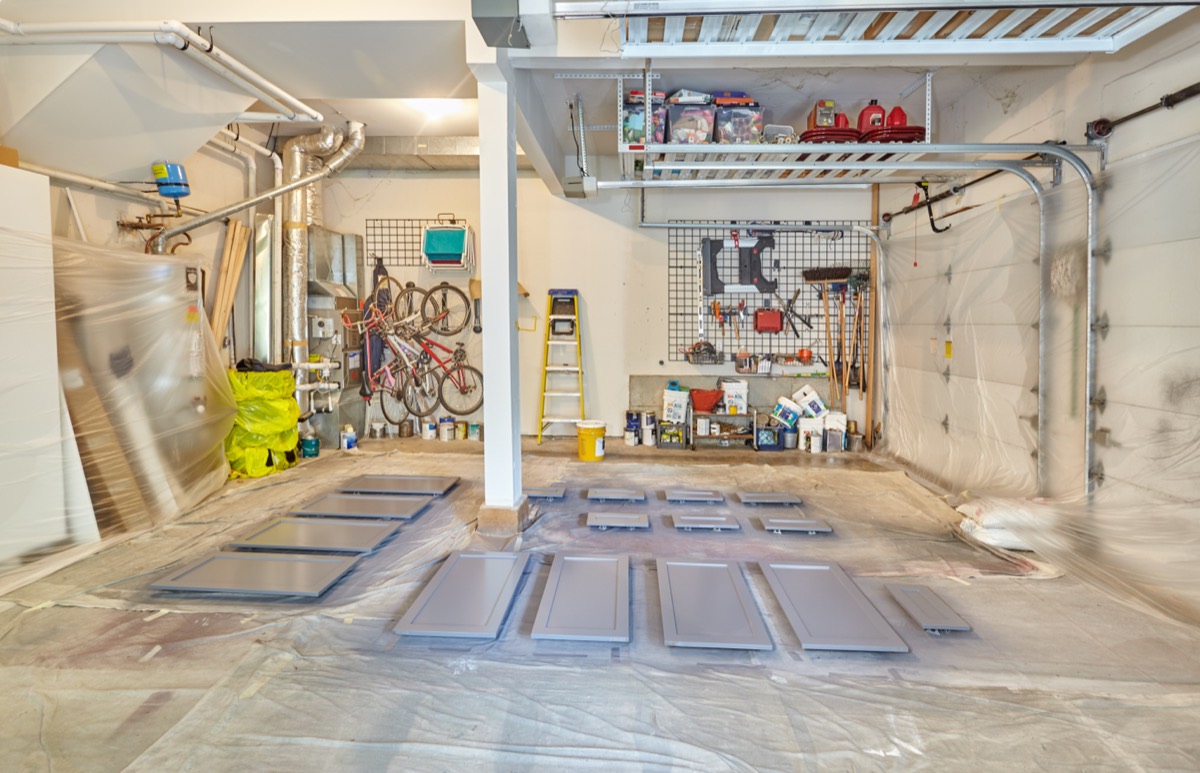
- Painted finishes are only as good as their prep and coating. Catalyzed or two-part finishes generally take more abuse than brushed latex. Ask what will be sprayed, and where. Doors are usually finished off-site and need dust-free curing; a hot garage in July is not a spray booth.
- Wood and wood veneer move with very low humidity. Solid slab doors can warp; veneered or engineered slab doors are more stable.
Whichever path you choose, ask your contractor one direct question: what is this product rated for, and does the warranty still apply in a house that sits at 90°F inside in August? Get the answer in writing.
When each option makes sense
Paint when
- The doors are solid wood or good MDF in a style you like (shaker, flat panel).
- Your budget is tight, or you're preparing to sell or rent.
- The finish is the problem, not the structure: dated oak, yellowed white, worn edges.
Painting doesn't fix sagging doors, cheap drawer boxes or a style you don't like. It changes color, not shape.
Reface when
- The boxes pass the inspection above, but the door style is the problem (raised-panel cathedral doors in a kitchen you want to feel modern).
- You want soft-close hinges and drawer slides without a tear-out.
- Your counters are in good shape, or newly replaced, and you don't want to disturb them.
- You can't be without a kitchen for long. Refacing typically takes days on site rather than weeks.
Replace when
- The boxes are particleboard with water or termite damage.
- You want a different layout, taller uppers, more drawers, or an island.
- You're replacing counters, flooring and appliances anyway.
- You're in a mid-century home and the original cabinetry is past saving, or you want period-correct slab doors built to fit (see the mid-century kitchen guide).
A quick comparison
| Question | Paint | Reface | Replace |
|---|---|---|---|
| Changes the door style | No | Yes | Yes |
| Fixes damaged boxes | No | No | Yes |
| Counters usually stay | Yes | Yes | Rarely |
| Permit usually needed | No | No | Only if plumbing, electrical or walls change |
| Typical time without a kitchen | A few days (doors off-site) | A few days | Several weeks, plus ordering time |
| Heat risk to watch | Prep and coating quality | Adhesive and film edges | Box material and door finish |
What goes wrong, and what we require
Cabinet jobs generate a specific kind of complaint: in-home pressure sales, “three-day” refacing jobs that run for months, wrong-size doors, peeling finishes and companies that close before the warranty does. Our partner agreement requires these:
-
No sign-tonight pricing
“Thirty percent off, but only if we sign tonight.” · 12% of cabinet complaints
Our standard: Nobody we refer will pressure you to sign the same day. Estimates stay valid for at least seven days.
Our partner agreement rules out same-day-only pricing and requires honoring the 3-day right to cancel (5 days for 65+). We flag financing that pays the company before the work is done.
-
Honest reface, paint or replace advice
“We paid replacement prices for refacing.” · Recurring in refacing complaints
Our standard: We'll tell you honestly whether painting, refacing or replacing fits your cabinets and budget.
Before any introduction, we ask about the cabinet boxes' condition and your goals, and our partner contractor can price painting, refacing and replacing, each in writing.
-
Construction spelled out
“Sold as solid wood, delivered as particleboard.” · 21% of cabinet complaints (defects)
Our standard: Your contract names the box material, door construction and finish.
The itemized scope lists the cabinet line, box material, door style and construction, finish type, and hinges and slides. Our partner agreement requires deliveries to be photographed and inspected before installation.
-
Drawings you approve
“The microwave didn't fit the cabinet built for it.” · 19% of cabinet complaints
Our standard: Cabinets aren't ordered until you've approved drawings based on on-site measurements and your appliance specs.
Our partner agreement requires field measurements, your appliance spec sheets, and a layout and elevations you sign before anything is ordered.
-
Realistic lead times
“Cabinets quoted at five weeks took five months.” · 31% of cabinet complaints
Our standard: You'll get a realistic lead time in writing, and demo waits until the cabinets are here.
Our partner agreement requires manufacturer lead times in writing, cabinets inspected on delivery, and no tear-out until they've arrived. You get updates whenever a date changes.
-
Warranty you can use
“The door peeled and the company was already closed.” · 24% of cabinet complaints
Our standard: You get the manufacturer's warranty and a written workmanship warranty, and we keep copies.
Our partner agreement requires at least a one-year written workmanship warranty and manufacturer warranties registered in your name. We keep your documents on file.
-
Inspected before installed
“Every replacement door arrived damaged too.” · Recurring in retail and RTA complaints
Our standard: Every box is inspected on delivery, so damage is caught before installation, not after.
Our partner agreement requires deliveries to be opened, checked and photographed. Damaged pieces are reordered right away, and your schedule is updated in writing.
-
One point person
“I was passed between five reps for one drawer.” · 42% of cabinet complaints (communication)
Our standard: One person handles your cabinet project from measure to final walkthrough.
Each job has one named contact at the contractor and one at our office. Our partner agreement requires messages returned within one business day.
From about 1,600 public complaints (BBB, Yelp, CSLB) about kitchen and cabinet work that we read in 2026. How we counted
Before you sign
- Check the license. Look it up at cslb.ca.gov: C-6 (cabinet and millwork) or B (general building) for refacing and replacement, C-33 for painting.
- Get the scope itemized. Door count, drawer count, door material and thickness, box veneer, hinge and slide brand, pulls, whether end panels and toe-kicks are included, and who removes and disposes of the old doors.
- See a sample door in your kitchen. Colors shift under desert light. Look at it in the morning and late afternoon.
- Keep the deposit small. California caps it at 10% of the contract or $1,000, whichever is less.
- Get change orders in writing, priced and signed before the work. “We found damage in the sink base” is the classic one; ask up front how it will be priced.
- Know your cancellation window. Three business days for a contract signed at home, five if you're 65 or older.
- Ask about protection and cleanup. Spraying in a kitchen means masking floors, counters and appliances. Ask what's covered and how dust is controlled.
- Plan around HOA rules. If you live in a country club or condo, the contractor will likely need to be on the gate list with insurance on file. See the condo remodeling guide.
Still undecided?
Ask for two prices from the same contractor: one to paint or reface, one to replace. A contractor who will price both, and explain which they'd choose for your kitchen and why, is usually the one worth hiring. We can introduce our licensed, insured partner contractor, which can price both ways in writing.
Common questions
Is refacing cheaper than new cabinets?
Usually, but not always by as much as people expect. National guides put refacing at roughly $1,500 to $12,500 for a kitchen, with about $7,000 typical (Inch Calculator), and installed stock-to-semi-custom cabinets at roughly $4,000 to $14,000 (Fixr). The real saving with refacing is that your countertops, plumbing and flooring usually stay put. If you're replacing the counters anyway, get both options priced.
How long does cabinet painting last?
A professionally prepped and sprayed finish on solid wood or MDF doors typically holds up for years with normal care. The weak points are prep shortcuts and the spots that take daily abuse: around the sink base, the trash pull-out and the most-used drawer fronts. Ask what primer and topcoat will be used and what the touch-up policy is.
Can thermofoil cabinets be painted or refaced?
Peeling thermofoil generally can't be painted well; the film has to come off first, and the core underneath is usually MDF that needs sealing. Many owners with failing thermofoil reface with new doors instead. In a hot kitchen or a house closed up all summer, choosing a different door material is the real fix.
Do I need a permit to reface or replace cabinets?
Not usually, if nothing else changes. Riverside County's exempt-work handout lists cabinets and countertops that don't change walls, plumbing, mechanical or electrical configuration. Moving the sink, adding circuits or opening a wall is permitted work everywhere in the valley. Cities run their own building departments, so your contractor should confirm.
What license should a cabinet contractor have?
For cabinet work, a C-6 (cabinet, millwork and finish carpentry) or a B (general building) license from the CSLB. Painting is covered by a C-33 painting license. Any job over $1,000 in labor and materials, or needing a permit, requires a license. Look it up at cslb.ca.gov before you sign.
How much can a cabinet company ask for up front?
California caps the down payment on a home improvement contract at 10% of the price or $1,000, whichever is less. After that, payments can't get ahead of work done and materials delivered. Refacing chains that ask for half at the kitchen table are asking you to waive a protection you have by law.
Last reviewed . Prices and rules change; confirm details with your contractor and your city or county building department.