Rancho Mirage, CA · Home theater
Home theaters in Rancho Mirage
Thunderbird and Tamarisk estates, Mission Hills villas, Del Webb homes and 1950s customs: Rancho Mirage has the space and the budgets for real theater rooms. What they typically cost and what to settle before anyone opens a wall.
- Free for homeowners
- Licenses checked at CSLB
- You contract directly with your pro
Quick answer
Fixr's national figures (January 2025) put most dedicated theater rooms at $10,000 to $50,000, about $25,000 on average, with high-end custom theaters near $100,000. Acoustic treatment alone runs about $1,200 to $10,000. Rancho Mirage Building & Safety handles permits online and requires a city business license for contractors.
Who to call: Coachella Valley Remodeling connects you with our licensed C-10 electrical / C-7 low-voltage partner contractor, who visits and gives you a written price. Free to you. Tell us about your project or call (760) 766-2218.
Rancho Mirage has the valley's oldest residents (median age 66), some of its most valuable homes (a median owner value around $807,000) and about a third of its housing used seasonally. Nearly every home sits in a country club or gated community. Put together, that means theater projects here are often large, built while the owner is elsewhere, and judged as much on how easy they are to use as on how they sound.
The room decides the project
A converted bedroom or den. The most common route in 1970s and 1980s club homes. A projector or a large TV, a 5.1 or 7.1 system, blackout shades and a few acoustic panels. Doors, ducts and windows are the weak points for sound; heavier doors and seals are cheap compared to rebuilding a wall.
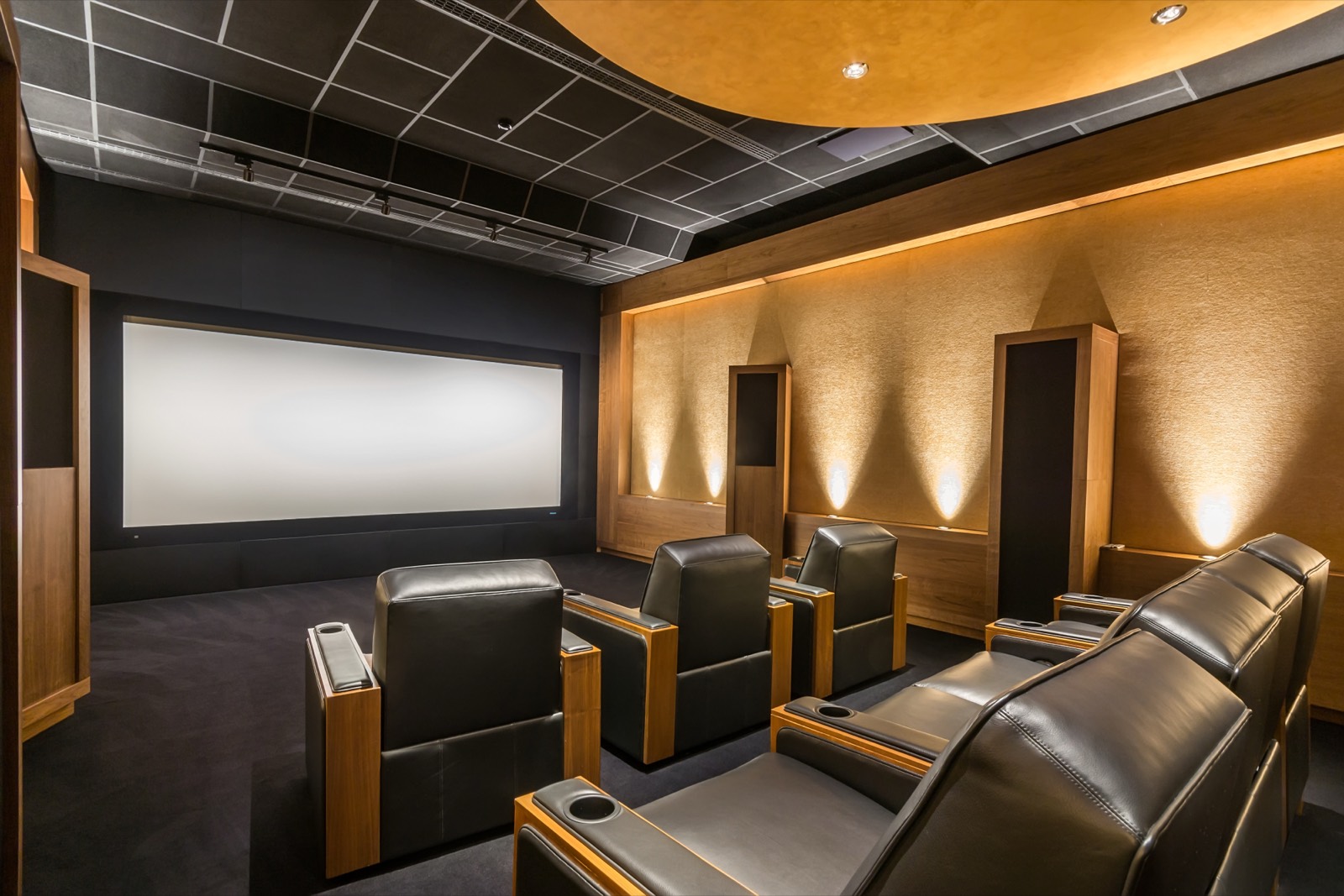
A purpose-built theater. In larger estates at Thunderbird, Tamarisk or Mission Hills, owners build a closed room: isolated walls and ceiling, tiered seating, an equipment closet with its own cooling, and a control system that dims the lights and starts the film from one button.
The great room. Many owners would rather have an excellent TV and hidden speakers in the room they actually live in. Architectural in-ceiling speakers and a TV that hides behind art or a panel suit mid-century customs, some of which are on the city's historic register.
What it typically costs
National figures from Fixr's home theater cost guide, updated January 2025:
| Level | Typical range |
|---|---|
| Media room upgrade | from a few thousand dollars |
| Most dedicated rooms | $10,000–$50,000 (about $25,000 average) |
| High-end custom theater | up to about $100,000 |
| Acoustic treatment | $1,200–$10,000 |
| Seating | $500–$20,000 |
Ask for a design, an equipment list with model numbers, and labor, programming and permits priced as separate lines. These ranges are not a quote.
Licenses, permits and city rules
Low-voltage audio, video and control wiring is C-7 work; outlets, dedicated circuits, recessed lighting and dimmers are C-10 electrical work, done by state-certified electricians. We refer Rancho Mirage theater projects to our licensed C-7 low-voltage / C-10 electrical partner contractor.
Rancho Mirage Building & Safety permits online and takes inspection requests by email, typically within 48 hours Monday through Thursday. If someone pulls a permit as your agent, the city wants a notarized letter, and every contractor needs a Rancho Mirage business license.
Ease of use is the real spec
The best theater is the one everyone in the house can start. Before you sign, ask the installer to describe exactly what happens when you press “watch a movie”: what turns on, what dims, which remote or app you use. Ask for large-button remotes or a simple wall keypad if that suits the household, and for the Wi-Fi and accounts set up in your name.
For owners who leave in May
Equipment closets get hot in an empty summer house, and an outage on Southern California Edison lines can leave a control system offline until someone resets it. Ask for remote monitoring of the equipment, a battery backup on the network gear, and a written plan for who visits if something needs a reset. Second-home services covers keys and access.
What we ask of the contractor
-
Permit pulled, inspection passed, before the final payment
“The panel went in without a permit, and it surfaced when we sold the house.”
Our standard: Panel, circuit, EV charger, generator and battery work is permitted, and you get the signed-off inspection before the final payment.
We ask the electrical partner to name the permit and its fee in the written price, schedule the city or county inspection, and send you the inspection result. A bid that leaves the permit out is a red flag, not a discount.
-
Utility work spelled out in the price
“The panel price doubled once the utility said the meter and service had to change.”
Our standard: The written price says what happens on the utility side (SCE or IID), what's included and what could change it, before you sign.
Service upgrades often need the utility to disconnect, approve or upgrade the service drop or meter. The written price should say who files with SCE or IID, what the lead time is, and what an unexpected utility requirement would cost.
-
A C-10 contractor and certified electricians for line-voltage work
“The low-voltage guy ran a new 240-volt circuit for the charger.”
Our standard: Anything at 120 or 240 volts goes to a C-10 electrical contractor whose electricians hold state certification; low-voltage AV, Wi-Fi and data wiring to a C-7 or C-10 licensee.
California requires a C-10 license for line-voltage work and DIR certification for the electricians a C-10 contractor employs. A C-7 low-voltage license covers systems at 91 volts or less. We check both on the CSLB site before any referral.
-
A handover you can actually use
“Six remotes, three apps, and nobody returns calls when the music stops.”
Our standard: At the end you get a walk-through, labelled equipment, a written sheet of the Wi-Fi, logins and accounts in your name, and support terms in writing.
We ask the partner for an itemized equipment list with model numbers, the passwords and admin accounts set up in the owner's name, and what a service call costs after the warranty period, all before the final payment.
-
No lock-in you didn't agree to
“Only the original dealer can change a scene, and they went out of business.”
Our standard: The written price names the platform (open or dealer-programmed) and whether you get the programming files or a dealer-transfer path.
Dealer-programmed systems such as Control4, Crestron and Savant are excellent, but changes usually need a dealer. Ask who owns the programming, and get it in writing. App-based systems are cheaper to change later; the written proposal should say which you're buying.
-
Clean walls and a mount rated for the TV
“Wires hanging down the wall, and the TV sagged off a drywall anchor.”
Our standard: The price says how cables are hidden, what the mount is rated for, how it attaches, and whether drywall patch and paint are included.
Desert homes often have block, stucco or post-and-beam walls, and many TV walls sit over a fireplace. Ask how the mount attaches to your wall, whether power is moved behind the TV as a code-compliant outlet, and who patches the wall.
-
Systems that come back after an outage
“The cameras went dark in July and nobody noticed until October.”
Our standard: For seasonal homes, remote alerts are set up and tested, the router and hub sit on battery backup, and the plan says who resets what when you're away.
Summer outages happen here in triple-digit heat. Ask for alerts for power loss, temperature and water leaks, a small UPS on the router and hub, and a written plan for a reset visit.
-
No pressure sales on batteries, generators or solar
“They said the battery was basically free and I had to sign that night.”
Our standard: No same-night signing. Incentives are stated as programs you apply for, with no promise that you'll get them.
CSLB warns that solar and storage draw more complaints than any other trade it oversees, often from high-pressure sales and 'free' claims. You get a written price, time to think, and the cancellation period the law gives you.
Nearby cities
Common questions
How much does a dedicated home theater cost in Rancho Mirage?
There are no local figures. Fixr's national numbers put most dedicated rooms at $10,000 to $50,000, about $25,000 on average, and custom theaters near $100,000. A converted bedroom with a projector and 7.1 sound sits at the low end; a built room with isolation, tiered seating and calibrated immersive audio sits at the top.
Control4, Crestron or Savant: which one?
All three are dealer-installed platforms that run a theater, lighting and shades from one interface. The bigger decision is the dealer: changes usually need one, so ask who owns the programming and what happens if you change dealers. Get the answer in writing.
Can work happen while I'm away for the summer?
Yes, and many owners prefer it. Rancho Mirage allows construction 7 a.m. to 7 p.m. Monday through Saturday, and summer schedules are easier. Ask for photo updates at each stage and a video walk-through before the final payment.
Does my HOA need to approve a home theater?
Interior AV work usually isn't architectural review, but associations still set contractor access, hours and noise rules. Anything outside, like a patio TV, speakers in the landscape or conduit on a wall, may need approval. Ask your club before scheduling.
Who actually builds the theater?
A licensed contractor, not us. We're a free referral service and refer Rancho Mirage theater projects to our licensed C-7 low-voltage / C-10 electrical partner contractor; you contract with and pay it directly.
Last reviewed . Prices and rules change; confirm details with your contractor and your city or county building department.